
Modal Key Signatures
They are modal and it matters.

The key center or the scale?
The key signature with no sharps or flats C D E F G A B is commonly thought to be the key of C (Ionian) Major but also the key of A (Aeolian) minor. This sets the stage for the idea that a key signature tells you the key relative to the position in the scale of the tonic center.
We decide if a song is C Major or A minor by looking at the note/chord that the song ends on and often, but not always that it begins on.
What are modes?
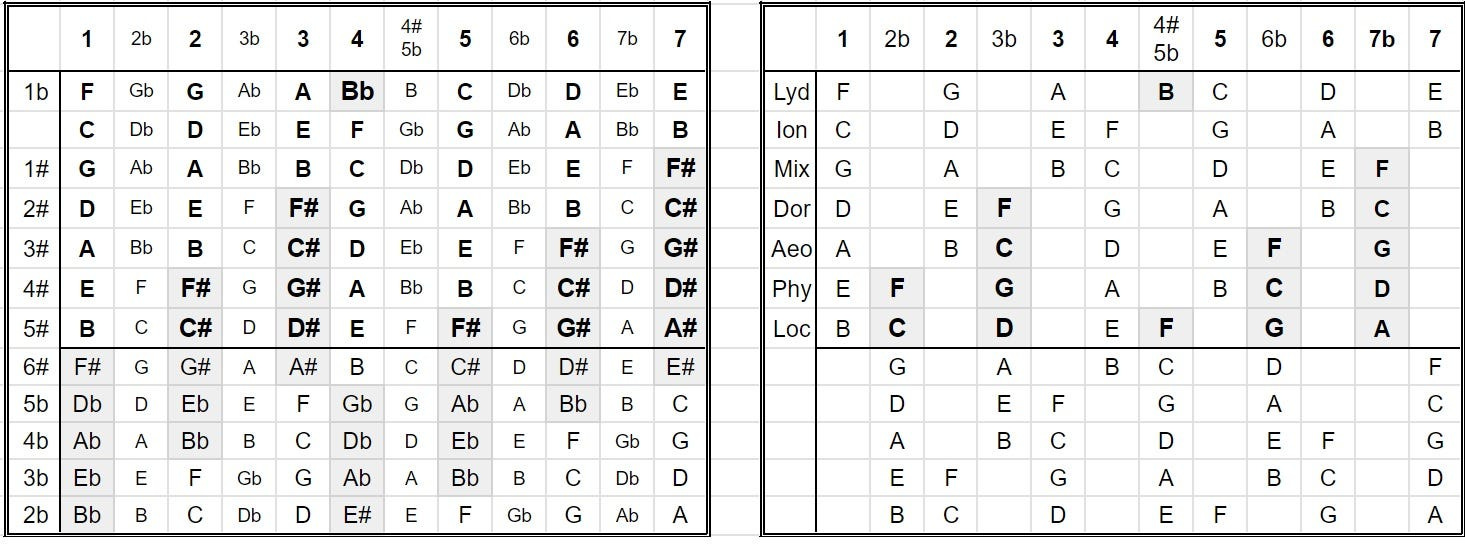
Moving CW by 5ths an additional note flattens and to “correct” the scale to Ionian Major that note gets sharped. Moving CCW by 4ths notes go sharp and must be flattened to “correct” the scale to Ionian Major. The modal scales on the right do not change the notes to Ionian Major. Since there are seven notes in the scale there are only seven named modes because the other five start on a sharp or flat note.
Keep in mind, the relationship not tied to these named notes. G Ionian Major is G A B C D E F# (scale degrees 1 2 3 4 5 6 7) and D Mixolydian is D E F# G A B C (scale degrees 1 2 3 4 5 6 7b). This will be important later.
Pentatonic Modes
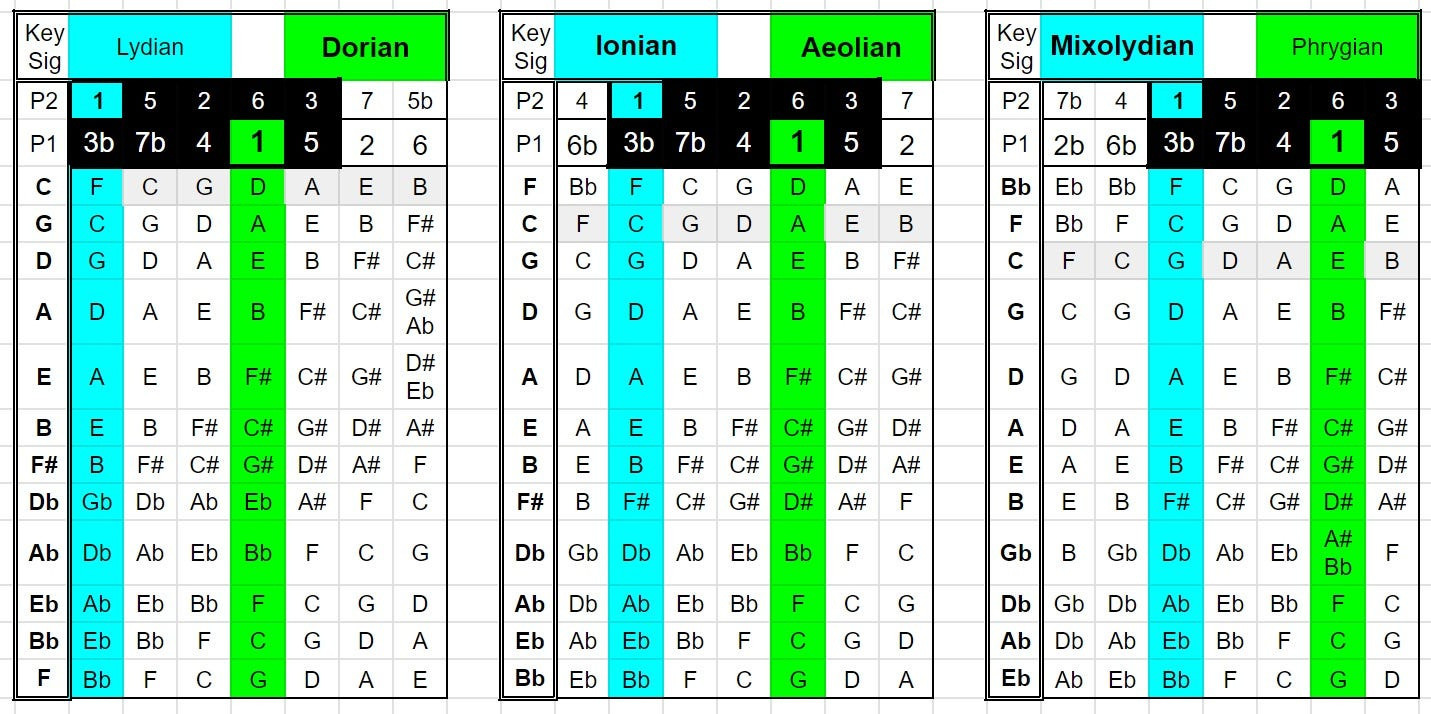
Pentatonic Mode 2 (Major) is scale degrees 1 2 3 5 6.
Pentatonic Mode 1 (minor) is scale degrees 1 3b 4 5 7b.
Notice that just as Ionian/Aeolian, Lydian/Dorian and Mixolydian/Phrygian use the same note sequence, the pentatonic modes 1 & 2 use the same note sequence. They just start at a different scale degree. Lydian, Ionian and Mixolydian are Major and Dorian, Aeolian and Phrygian are their relative minors.
Old Joe Clark
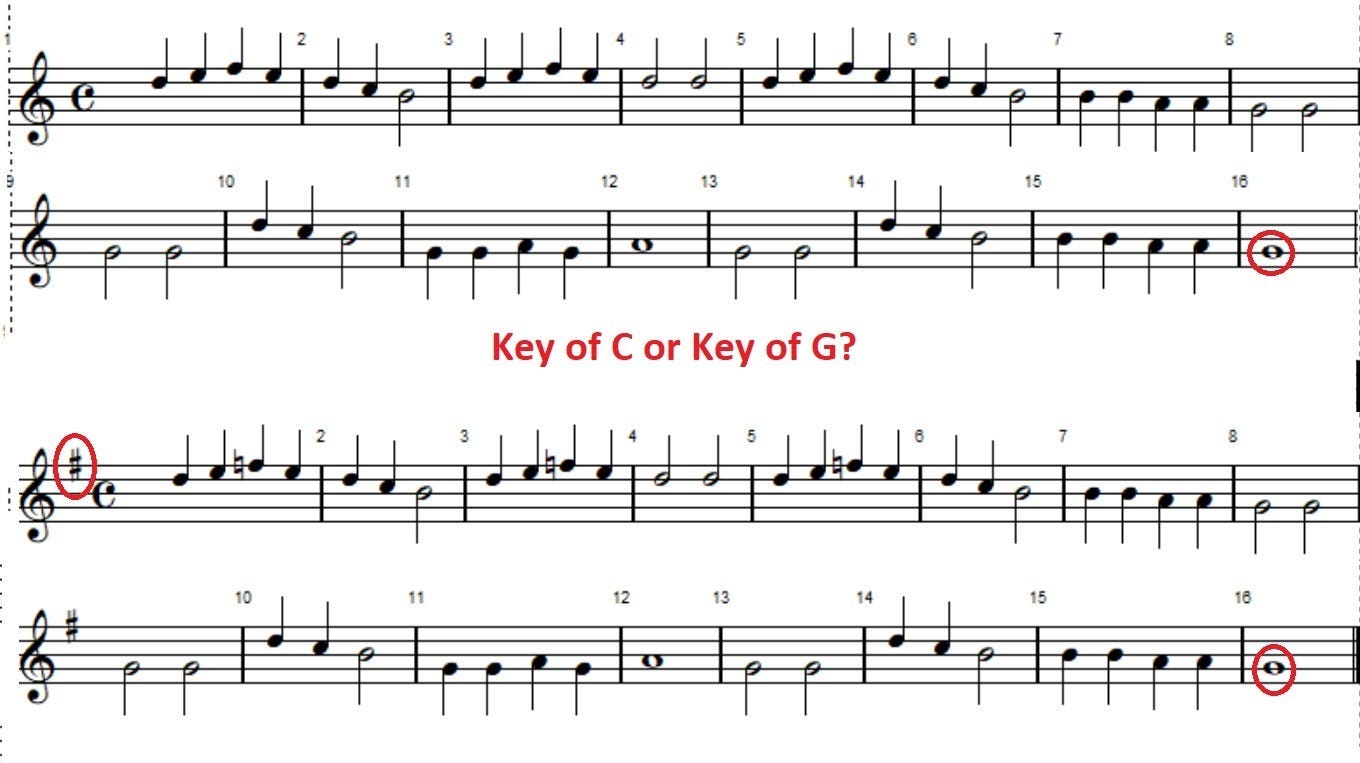
Old Joe Clark is shown in Figure 1 as G Mixolydian (bottom two bars). It is shown with the key signature for C in the top two bars. Some people, like me, prefer the uncluttered C representation because the F that gets flattened in measures 1, 3 & 5 are not accidentals, they are part of the G Mixolydian scale. We know it is the key of G because it resolves to G.
Looking at the box on the right in Table 2 we see that G Mixolydian can be expressed as C.
Cluck Old Hen
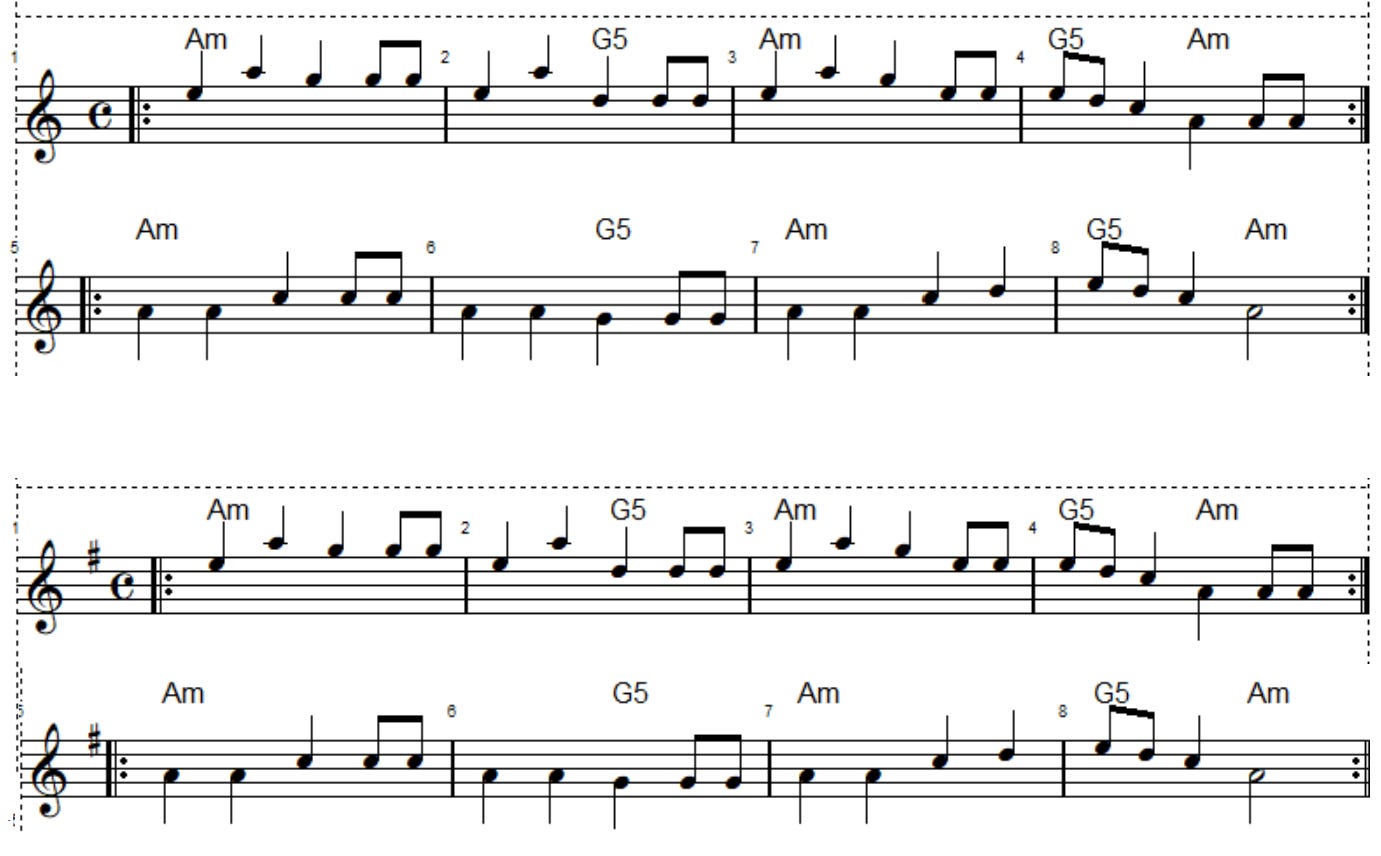
Cluck Old Hen has the notes A C D E G, Pentatonic mode 1: 1 3b 4 5 7b.
Looking at Table 2 there are three possible key signatures that have the notes A, C, D, E & G under the black blocks for the pentatonic scales. G (1#) on the left, C in the center and F (1b) on the right. Since A minor is known to be the relative minor of C it is an obvious choice. Neither the F# or Bb are notes in the pentatonic scale so they would be superfluous.
The reason that I include this example is the harmony chords. The song is considered to be “modal.” The A minor chord uses the notes A C E which are notes in the pentatonic scale, but the G chord needs a B or Bb to make it Major or minor. We can only make a G5 chord and keep the song “modal.” There is no mode policeman who will come after you if you play a Major or minor G, but it detracts from the modal character of the song.
People will argue.
As fate would have it, on the Facebook Cover Band Central page there was a picture of a man holding up a sign that said, “Sweet Home Alabama is in G Major.” The comments went wild. “It’s G.” and “It’s D Mixolydian, the tonal center is D” with all sorts of explanations.
Do we need to argue or be confused? I don’t think so. It is easy enough to figure out the key (where does it resolve) even if the “key signature” is something different because the tune is modal. It seems less cluttered to me.
I do not have a formal music education beyond an elementary school music class that seems to no longer exist. If someone with a formal music education stumbles onto this, what is preferred/proper? A comment would be welcome.